
Pete’s Presentations

Phillip Martin has outdone himself with his collection of sites offering educators FREE PowerPoint presentations, education websites, and clipart.  The main site, Pete’s PowerPoint Station, has links to numerous resources.  I’d recommend viewing all of the themes and topics at Pete’s Presentations because you can look at all of the possibilities.  Sub-sites include Gretta’s Game Station and Hannah’s Homework Help Station.  Don’t miss the clipart link.  Mr. Martin’s unique, colorful cartoon style appeals to all children.

As long as you use it for your classroom (newsletters, website, interactive whiteboard lessons, self-made worksheets, etc.), these amazing resources are yours at no cost.  He does ask that you tell someone else about the site.  I’d say that is the least we can do to thank Mr. Martin for his outstanding artistry and organization.  This is a teacher’s jackpot!

Pete’s Presentations
http://www.pppst.com/themes.html

Gretta’s Games
http://games.pppst.com/index.html

Hannah’s Help
http://resources.pppst.com/index.html
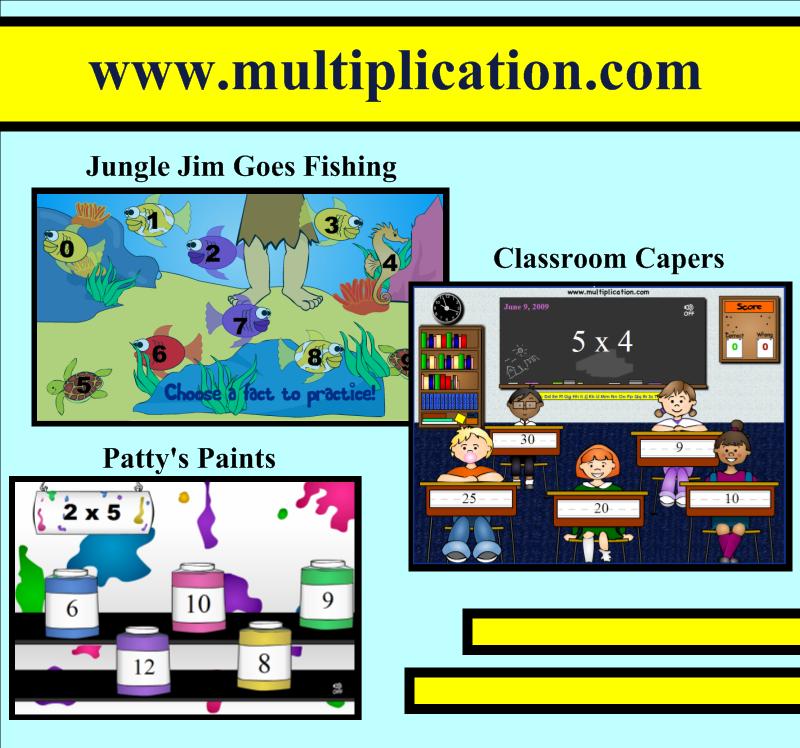
www.multiplication.com

If you are a teacher or parent of a school-age child, www.multiplication.com is the best site I’ve found for practicing the basic X facts.  This site includes worksheets, timed tests, hands-on classroom games, and flash cards, but the real treasure is the assortment of interactive computer games for learning individual fact families.  While mixed practice is also available, it’s wonderful to focus on just the recently introduced fact family.  The plethora of games includes “Classroom Capers,” “Jungle Jim Goes Fishing,” and “Patty’s Paints.”

I like to model a new game for the entire class each week.  Then, while the students complete a practice worksheet on the fact family we are currently learning, one student goes to the SMART™ Board to play the game and another watches and waits in the batter’s box.  For some games, the student can take the full timed minute to try to answer as many questions correctly and attempt to earn a high score.  In these cases, the game becomes a competition amongst the students.  Other games may require a limit of 5 problems per student, because the rounds take several minutes to complete.  It may also depend on the amount of time you can set aside and the number of students in your classroom.  I find that as students finish the independent worksheet, they watch their classmates at the SMART™ Board.  This allows the other students to finish their paper assignment at their own pace, and keeps early finishers engaged.